Punjab Newsline | New Delhi
India and neighbouring countries could face an unusually challenging winter as a strong El Niño phenomenon threatens to disrupt weather patterns across the Himalayan region.
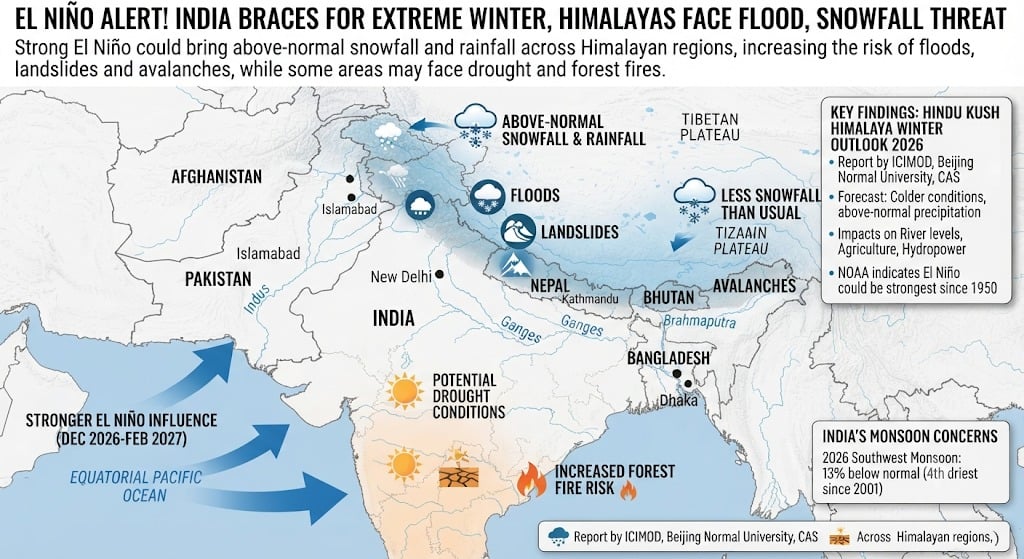
Scientists have warned that excessive rainfall and snowfall in several areas could trigger floods, landslides and avalanches, while other parts of the region may experience dry spells and an increased risk of forest fires.
According to the Hindu Kush Himalaya Winter Outlook 2026, the impact of El Niño is expected to be felt across Nepal, Afghanistan, Bangladesh and parts of northern India. The outlook forecasts colder conditions and above-normal precipitation in several parts of the region, raising concerns over weather-related disasters.
The US National Oceanic and Atmospheric Administration (NOAA) has indicated that El Niño is developing at a strong to very strong intensity. There is approximately a 60 per cent probability that it could become the strongest such event since records began in 1950.
The report has been jointly prepared by the Kathmandu-based International Centre for Integrated Mountain Development (ICIMOD), Beijing Normal University and the Institute of Atmospheric Physics under the Chinese Academy of Sciences.
ICIMOD scientists have warned that El Niño could bring heavier rainfall to the Himalayan foothills, while higher-altitude regions may witness increased snowfall. These changes could significantly affect river water levels, agriculture, hydropower generation and water availability across the region.
The outlook has also highlighted the possibility of drought conditions in certain areas, which could increase the risk of forest fires.
The warning comes after a particularly destructive monsoon season in Nepal and Bhutan, during which disasters linked to changes in glaciers and permafrost in high-altitude mountain regions caused extensive damage.
In August, devastating floods in Nepal's Bhotekoshi region reportedly claimed at least 1,500 lives, while more than 5,000 people were reported missing.
The report forecasts deeper-than-normal snow accumulation in parts of Afghanistan, Pakistan, northern India and Nepal. In contrast, some areas of Bhutan and eastern Xizang in China may receive less snowfall than usual.
El Niño is expected to reach its peak around December this year, potentially pushing temperatures above normal across large parts of the world in the coming months. The World Meteorological Organization (WMO) has also warned that changing rainfall patterns could increase the likelihood of droughts and floods in different regions.
According to the WMO, the influence of the phenomenon could persist across the Northern Hemisphere until the spring of 2027. The organisation has indicated an almost 100 per cent probability of El Niño conditions continuing through February 2027.
Rising temperatures could further increase the risk of heat-related illnesses, including heatstroke, while irregular rainfall may lead to water shortages in some areas and flooding in others.
El Niño raises concerns over India's monsoon
India has already witnessed the impact of El Niño on its monsoon performance. The 2026 southwest monsoon ended with rainfall 13 per cent below normal, making it the country's fourth driest monsoon since 2001.
The impact of El Niño was also observed during the second half of the monsoon season, raising concerns about rainfall patterns, agricultural conditions and water availability in the months ahead.