Punjab Newsline | Chandigarh
In a major urban planning reform ahead of the 2027 Assembly elections, the Punjab Government has approved the Punjab Urban Planning and Development Building (Amendment) Rules, 2026, paving the way for legally recognised mixed-use developments where residential and commercial activities can operate within the same complex.
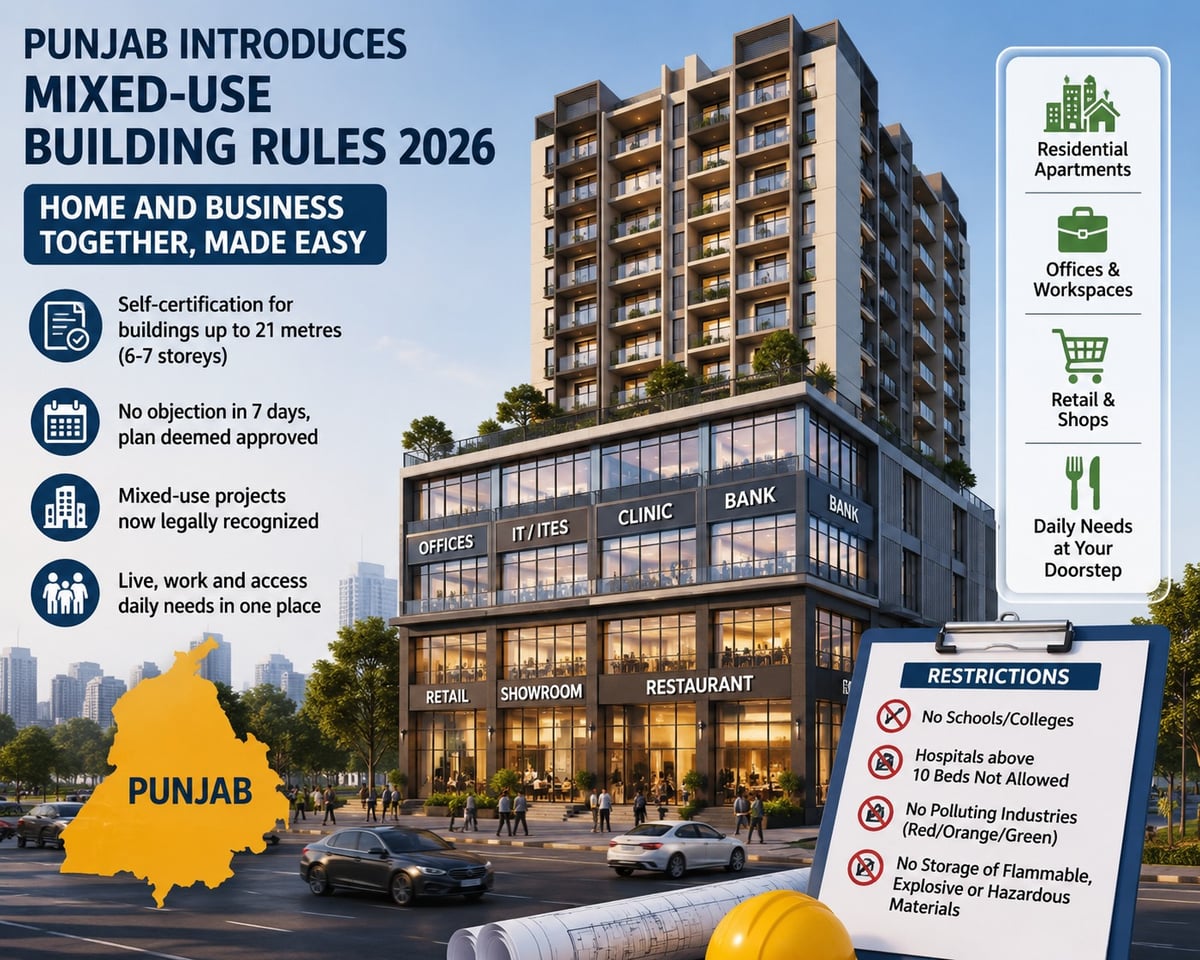
New rules, effective from July 15, also introduce a self-certification system for approving building plans and issuing completion certificates for structures up to 21 metres (around six to seven storeys). Under the new mechanism, empanelled architects authorised by the department can certify such projects. If no objection is raised within seven days, the building plan will be deemed approved.
Mixed-Use Projects Get Legal Recognition
For the first time, Punjab has formally recognised mixed-use projects, allowing residential units, retail outlets, offices, IT/ITeS companies and other government-approved commercial activities to function within a single integrated development.
The objective is to create modern "live-work" communities where residents can access workplaces, shopping and essential services without travelling long distances.
To qualify as a mixed-use project, developers must have:
A minimum land area of 8,000 square metres
A 24-metre-wide approach road
Multi-Level Functional Design
The new model allows different floors of the same high-rise building to serve different purposes.
Lower ground and ground floors: Retail shops, showrooms, department stores and restaurants.
First and second floors: Corporate offices, banks, IT companies, workspaces and clinics.
Upper floors: Residential apartments, including luxury apartments, studio apartments and penthouses.
Officials believe the integrated design will reduce commuting, lower vehicle usage and improve convenience for residents.
New Standards for Urban Infrastructure
The amended rules also prescribe fresh norms for:
Mixed-use developments
Multi-level parking facilities
Floor Area Ratio (FAR)
Green spaces
Parking requirements
Fire safety standards
Restrictions on Certain Activities
To preserve the residential character of these developments, several activities have been prohibited, including:
Schools and colleges, to avoid heavy student movement affecting residents' privacy.
Hospitals with more than 10 beds, citing concerns over infection risks and medical waste.
Polluting industries falling under the Pollution Control Board's Red, Orange and Green categories.
Storage of any flammable, explosive or hazardous materials.
Additional Construction Relaxations
The revised rules also allow homeowners to construct the plinth level up to 600 mm above the road crown level. Additional concessions will be available for buildings with basements, subject to specified conditions.
However, the maximum permissible height for residential buildings will remain 13 metres, despite the broader reforms.
The state government says the amendments are intended to modernise Punjab's urban development framework, simplify approvals, encourage integrated town planning and improve the ease of doing business while maintaining safety and environmental standards.