Punjab Newsline | Chandigarh
By : Jaansheen Singh Bajwa
Punjab is planning to introduce advanced sports science technologies to strengthen athlete training and improve preparations for major international sporting competitions, including future Asian Games campaigns.
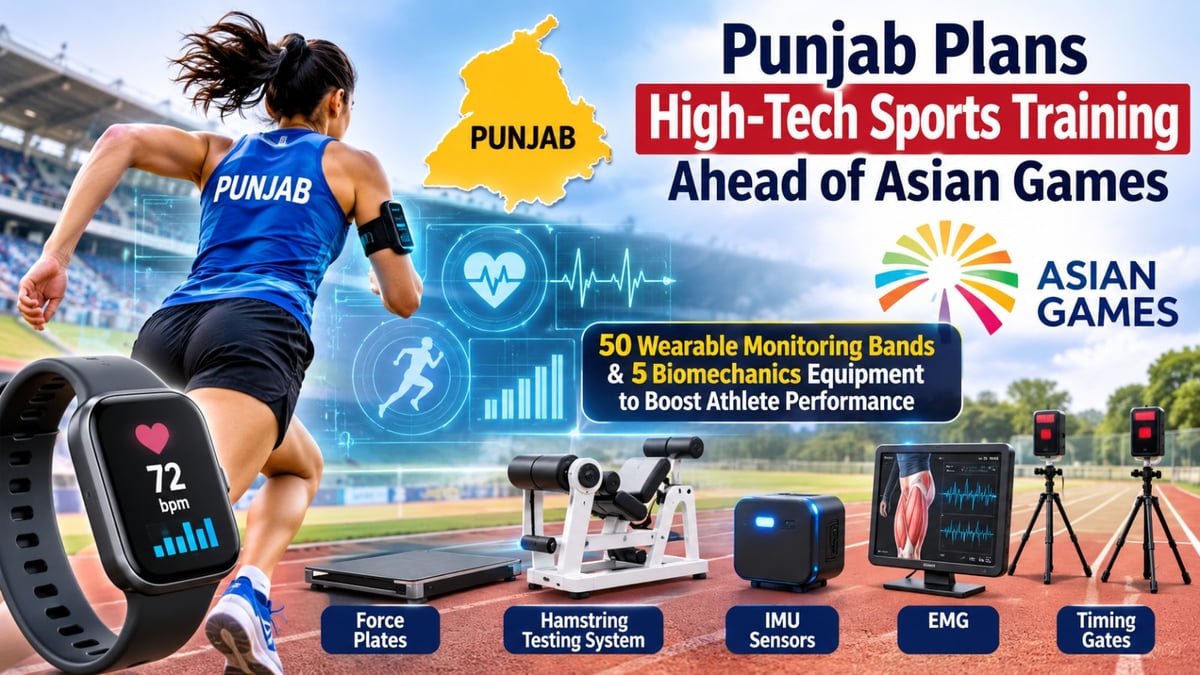
The state Sports Department is planning to procure 50 continuous physiological performance and recovery monitoring bands, along with a specialised biomechanics testing system comprising five categories of equipment.
The initiative aims to bring scientific assessment into sports training, enabling coaches and sports specialists to evaluate athletes through measurable performance data rather than relying solely on conventional fitness tests and visual assessments.
Wearable Bands to Monitor Athletes' Fitness and Recovery
The proposed 50 wearable monitoring bands will help record athletes' physiological and activity-related information. Depending on their technical specifications, the devices may track heart-rate trends, physical activity and recovery-related indicators.
The data will help coaches understand how athletes respond to different training loads, identify signs of fatigue and determine whether adjustments in training intensity or additional recovery time are required.
Five Advanced Technologies to Assess Strength and Performance
The planned biomechanics testing system will include Force Plates, a Hamstring Strength Testing System, Inertial Measurement Units (IMUs), Electromyography (EMG) and Timing Gates.
Force Plates: Two force plates will measure the forces generated by athletes during standing, jumping and other physical movements. The technology can help assess strength, balance, jumping ability and differences in force production between the two legs.
Hamstring Strength Testing System: The specialised equipment will assess hamstring muscle strength, which plays a crucial role in sprinting, acceleration and changes of direction. It can help identify muscle imbalances and assist coaches and physiotherapists in designing strength and rehabilitation programs.
Inertial Measurement Units (IMUs): These motion sensors will help analyse acceleration, orientation and movement patterns. When attached to athletes or specific body segments, they can provide insights into running techniques, jumping and turning movements.
Electromyography (EMG): This technology records the electrical activity produced by muscles. It can help sports specialists understand which muscles are activated during specific movements and how muscle activation changes during exercise.
Timing Gates: The sensor-based system will measure athletes' sprinting speed and acceleration by recording the time taken to cross designated checkpoints. It can be used to assess performance over distances such as 10, 20 and 30 metres.
Scientific Assessment to Help Coaches Customise Training
The combined use of wearable monitoring devices and biomechanics equipment could provide coaches with a more comprehensive understanding of individual athletes' physical conditions.
The collected data may help identify performance weaknesses, customise training programmes and monitor improvements in strength, speed and movement efficiency.
The technology could also support injury rehabilitation by allowing physiotherapists and sports specialists to track athletes' physical progress before they return to competitive training.
However, effective implementation will require trained sports scientists, physiotherapists and technical experts who can interpret the data and translate scientific measurements into practical training programs.
Focus on Preparing Athletes for International Competitions
The proposed initiative reflects an effort to incorporate sports science into Punjab's athlete development and competitive preparation framework.
Scientific performance assessment could help coaches make more informed decisions about training intensity, physical conditioning and recovery as athletes prepare for national and international competitions.
The impact of the initiative will depend on the availability of the equipment across sporting disciplines, its effective utilisation and the development of a trained technical support team.