Punjab Newsline | Chandigarh
By : Samriti Sharma
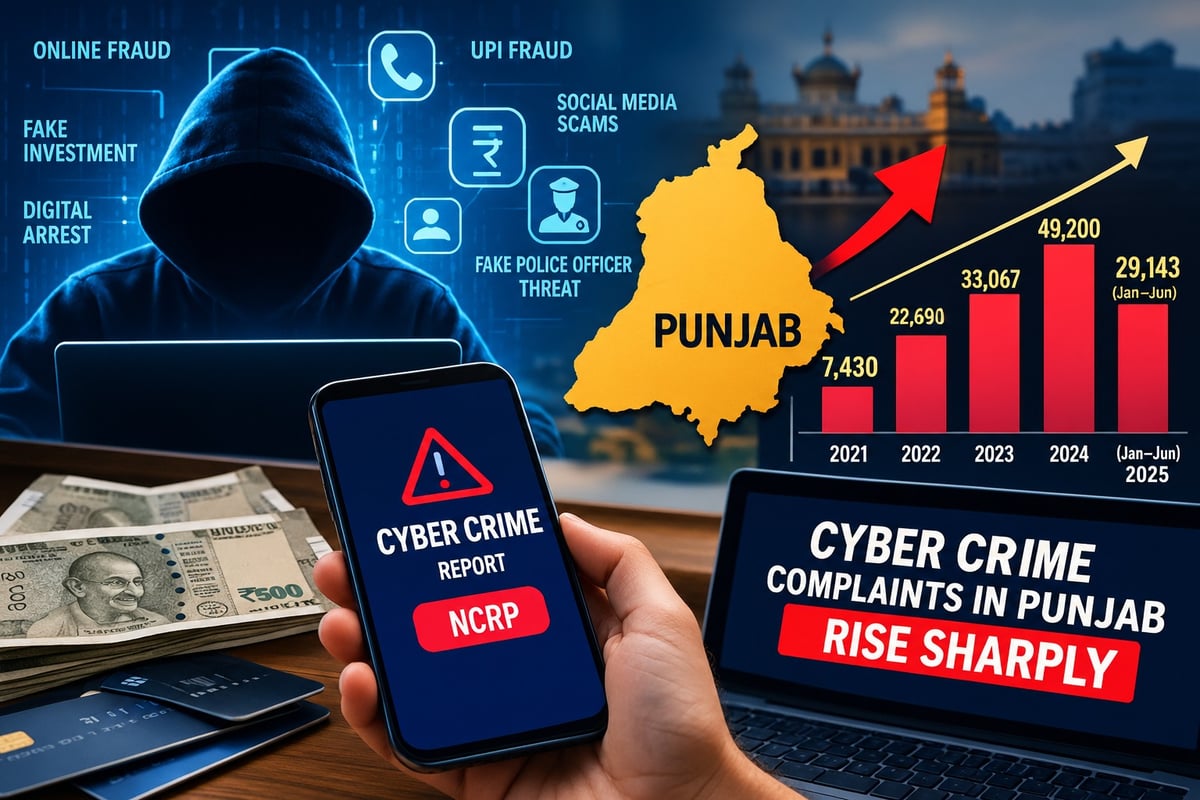
Punjab has witnessed a dramatic rise in cyber crime over the past four years, with complaints registered on the National Cyber Crime Reporting Portal (NCRP) increasing more than sixfold between 2021 and 2024. Government data shows that cyber crime incidents reported from the state climbed from 7,430 in 2021 to 49,200 in 2024, highlighting the growing scale of online fraud and digital offences.
The trend has continued into 2025, with 29,143 complaints already registered on the NCRP by June 30. This figure represents nearly 59 per cent of the total complaints recorded during the entire year of 2024, indicating that cyber threats continue to expand across the state.
Cyber fraud is no longer limited to online banking scams. Cases involving fake investment schemes, UPI fraud, “digital arrest” scams, impersonation of police and government officials, social media fraud, and other online crimes are increasingly being reported.
The NCRP, operated under the Indian Cyber Crime Coordination Centre (I4C), serves as a national platform for reporting cyber offences, while investigation and FIR registration are handled by the respective state police agencies.
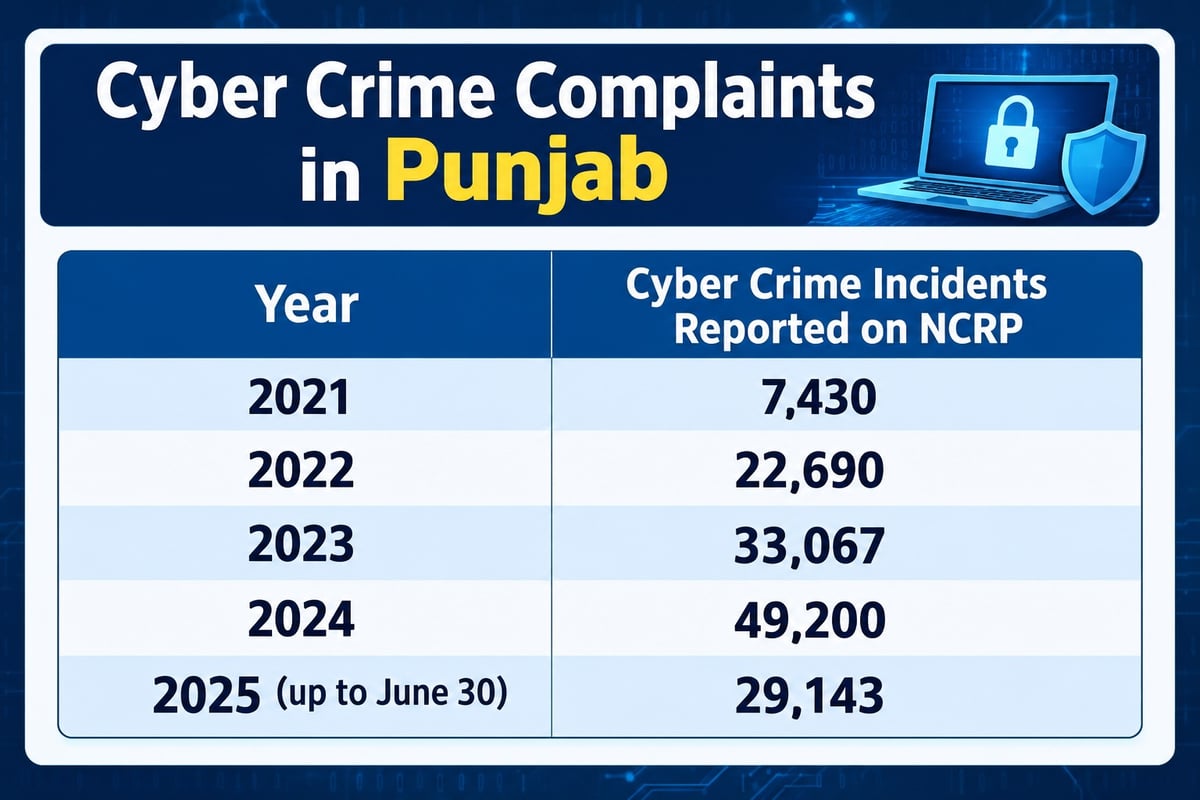
The sharpest rise was recorded between 2021 and 2022, when complaints more than tripled. The numbers continued to grow in subsequent years, reaching 33,067 in 2023 and 49,200 in 2024.
In 2024, Punjab recorded an average of around 135 cyber crime complaints every day. During the first six months of 2025, the daily average rose further to nearly 161 complaints.
Officials clarify that every complaint registered on the NCRP does not automatically translate into an FIR or a proven crime. Complaints are scrutinised by law-enforcement agencies, which then decide on registration of cases and further action.
Cyber Frauds Involving Hundreds of Crores
Cyber crime has also resulted in substantial financial losses. According to information provided by the Ministry of Home Affairs in the Rajya Sabha on March 12, 2025, Punjab had reported 75,087 cyber fraud incidents on the NCRP by February 28, 2025. The total amount involved in these cases was approximately ₹740.93 crore.
Authorities were able to place a lien or freeze action on around ₹101.51 crore, underscoring the importance of rapid reporting and coordination between law-enforcement agencies and financial institutions.
Major Urban Centres Report Highest Complaints
While a comprehensive district-wise NCRP database is not publicly available, reports from Punjab Police’s Cyber Crime Wing in October 2024 indicated that Mohali, Ludhiana, Jalandhar, Patiala and Amritsar were among the districts reporting the highest number of cyber crime complaints. The concentration of businesses, banking activity and digital transactions in these cities is believed to contribute to the higher complaint volumes.
Punjab Introduces e-Zero FIR System
To speed up action against cyber fraud, Punjab Police introduced an e-Zero FIR mechanism in July 2026 for eligible cyber financial fraud cases involving more than ₹5 lakh. Complaints received through the NCRP or the 1930 cyber helpline can now be automatically converted into e-Zero FIRs and routed through the Crime and Criminal Tracking Network and Systems (CCTNS) to the relevant cyber crime police station.
Cases involving frauds of ₹1 crore or more are being referred to the State Cyber Crime Police Station in Mohali for investigation.
Importance of Reporting Through 1930
Authorities continue to stress the importance of immediately reporting cyber frauds through the 1930 Cyber Crime Helpline and the NCRP portal. Early reporting improves the chances of freezing fraudulent transactions before money is transferred through multiple bank accounts or digital wallets.
The data reflects a significant shift in the nature of crime reporting, with victims increasingly turning to digital platforms before approaching police stations. As cyber-enabled offences continue to rise, officials say prompt reporting and public awareness remain the most effective tools in combating online fraud.