Punjab Newsline | Mohali
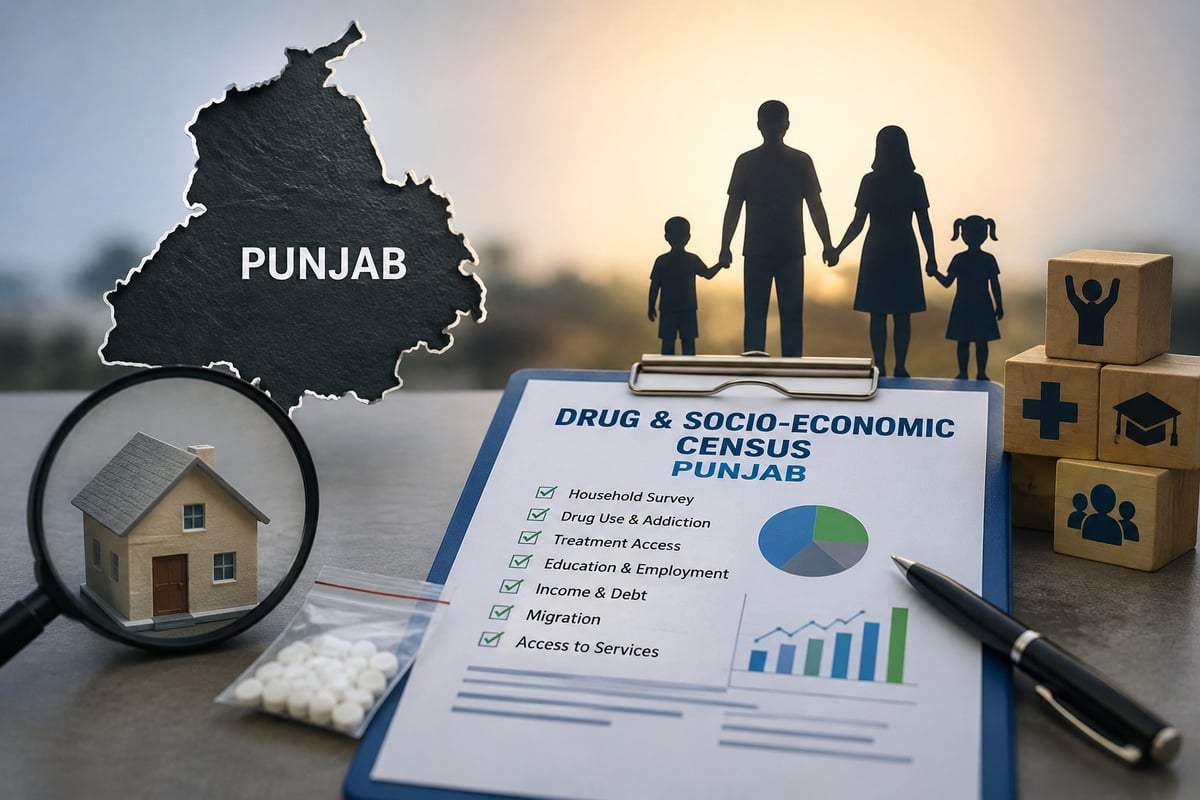
Punjab’s first-ever Drug and Socio-Economic Census, launched to assess the extent of substance abuse and its impact on families, is nearing completion with the government covering 55.36 lakh households against a target of 55.61 lakh. This translates to an impressive 99.56 percent coverage across the state.
According to official figures, 3.48 lakh families either declined to participate or did not cooperate with the survey process. To ensure data accuracy, 51.88 lakh surveys underwent verification through an Artificial Intelligence (AI)-based quality assessment system. Of these, 44.63 lakh surveys were approved, while 7.24 lakh surveys—around 13.96 percent—were flagged for manual quality checks.
District-wise data shows that Amritsar surpassed its target, completing 4,80,030 surveys against a target of 4,75,079, achieving 101.04 percent coverage. Mansa, Tarn Taran, Sangrur, and Ferozepur also exceeded 100 percent coverage, while Fazilka, Moga, and Pathankot met their respective targets.
Faridkot recorded the lowest coverage at 95.32 percent, followed by SAS Nagar (98.04 percent), Rupnagar (98.13 percent), and Ludhiana (98.15 percent). In absolute numbers, Ludhiana registered the largest shortfall, completing 6,46,634 surveys against a target of 6,58,844, leaving 12,210 households uncovered.
The census, launched in April, involved nearly 28,000 government employees. Beyond identifying individuals affected by substance abuse, the survey gathered information on the nature of addiction, duration of drug use, treatment status, and access to de-addiction centres. It also collected socio-economic data, including education, employment, income, land ownership, debt, migration, and overseas aspirations.
The survey further included questions related to caste and sub-caste, along with experiences of discrimination in accessing government services, schools, healthcare facilities, religious places, and water sources. Opposition parties had criticized the inclusion of such extensive questions, alleging that the government was collecting social and public sentiment data ahead of the 2027 Assembly elections.
The government will now consolidate and analyze the collected data. A committee headed by Chief Secretary K.A.P. Sinha, with secretaries from concerned departments as members, has been constituted to study the findings. The panel will assess drug trends, affected regions, patterns of substance abuse, and the socio-economic conditions of impacted families, and will recommend new policies and welfare measures based on the survey results.