Last year, our leadership team ran two strategy offsites. The first was at a four-star business hotel in Gurgaon. Big conference room, decent projector, passable lunch buffet. Standard stuff. We got through the agenda. People checked their phones under the table. Nobody mentioned it again.
The second was at a heritage property in Rajasthan. Desert on three sides. No malls within 30 kilometres. Evening sessions happened on a rooftop terrace with the fort lit up behind us. Someone suggested we scrap the org chart and restructure around customer segments — an idea that had been floating in Slack for eight months but never got airtime because there was never enough “space” in our regular meetings.
We restructured. Revenue went up 22% that quarter. I’m not saying the venue did that. But I’m not saying it didn’t.
The Science Is Boring but Real
There’s actual research behind this, and I’ll keep it brief because nobody reads white papers at cocktail parties. A study from the University of Utah found that people score 50% higher on creative problem-solving tasks after spending time in unfamiliar natural settings. The theory is straightforward — when your brain isn’t processing the same visual inputs it handles every day (your desk, the same elevator, that one flickering tube light in the pantry), it has spare capacity for original thinking.
Harvard Business Review published a piece a few years back making the case that physical distance from your regular workspace creates psychological distance from your regular thinking patterns. You’re literally too far from the office to think in office mode.
None of this is rocket science. You already know that your best ideas don’t come during meetings. They come in the shower, on a flight, during a walk. An offsite at the right location simply manufactures those conditions for an entire team, at the same time.
What “Outside the City” Actually Means

I’m not talking about the resort 45 minutes from the airport that your company has been going to since 2019. That place is basically a conference room with a pool view. Half your team is answering emails by lunch because they can feel the office gravitational pull.
Proper distance means your team can’t easily pop back. It means a flight or a 5+ hour drive. It means the nearest distraction is a sand dune, not a shopping mall. That barrier does something useful — it tells people’s brains that normal rules don’t apply here. You can think differently because you’re somewhere different.
Places like Rajasthan’s desert belt, Uttarakhand’s hill stations, or the Konkan coast work precisely because they feel remote without being inaccessible. Jaisalmer is three hours from Delhi by flight. But once you’re there, the Thar Desert has a way of making you forget that cities exist.
How to Pick a Venue (The Checklist Nobody Gives You)
I’ve planned enough offsites to know that the venue decision gets made on vibes and photos. Someone googles “nice offsite venues,” clicks through five websites, picks the one with the best hero image. That approach is how you end up with a beautiful property that has one meeting room, no Wi-Fi backup, and a kitchen that can’t handle 80 people eating at the same time.
Here’s what to actually look for.
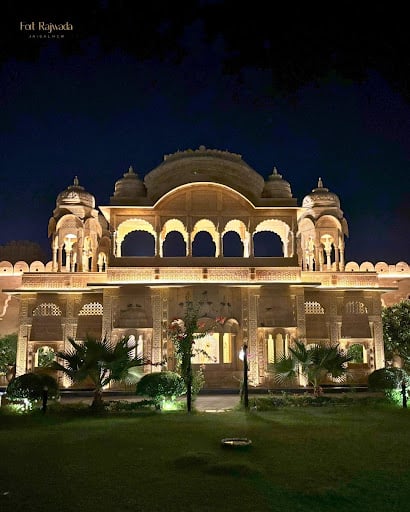
Can the entire group sleep under one roof? This is the single most important question. If half your team is at the venue and the other half is at a hotel down the road, you’ve already fractured the experience. The corridor conversations, the 11 PM chai run, the 6 AM walk before sessions start — that’s where the real bonding happens. It only works if everyone’s on the same property. A standout corporate offsite venue in Jaisalmer like Fort Rajwada, with 90+ rooms and suites, six distinct event spaces, and in-house catering, is ideal for leadership retreats and team off-sites — your entire group stays, eats, and works on a single 6-acre heritage campus without splitting across properties.
Does it have multiple distinct spaces? A two-day offsite in the same room gets stale by hour four. You need variety. Main sessions in a conference room. Breakout groups on a lawn or terrace. Meals somewhere else entirely. Evening activities in a courtyard or by a pool. The physical shift between spaces resets attention spans. Properties with multiple event areas — indoor meeting halls, outdoor lawns, poolside zones, rooftop terraces, heritage courtyards — let you design a different setting for every session. If a venue only has one banquet hall and a restaurant, keep looking.
What happens after 6 PM? Most corporate event planners spend 95% of their energy on the daytime agenda and 5% on the evenings. Invert that. The evening is where teams actually connect. Does the venue have outdoor spaces for a bonfire or barbecue? Can they arrange local entertainment — folk musicians, cultural performances? Is there a bar or lounge where people naturally gather? If the answer to all three is “no,” your team will retreat to their rooms and scroll Instagram. That’s not an offsite. That’s a hotel stay with extra steps.
Is the food a feature or an afterthought? Your team will remember two things from the offsite: whether they felt heard, and what they ate. Corporate buffets are universally forgettable. Properties with in-house chefs who cook regional specialities turn meals into experiences. A Rajasthani thali under the stars or a Konkan seafood dinner on a terrace — that’s employer branding your HR team didn’t have to budget for.
Can they handle the tech basics? Projector, screen, decent sound, and Wi-Fi that doesn’t collapse when everyone connects. Sounds obvious. It isn’t. Remote heritage venues sometimes run on older electrical systems. Ask specifically about power backup and bandwidth. One dead projector during the CEO’s presentation and the whole trip’s narrative changes.
The Budget Conversation Your CFO Is Dreading
Let’s get this out of the way. A destination offsite costs more than booking the nearest Novotel. Not wildly more — maybe 20–40% depending on flights and group size — but the line item is bigger and the CFO will notice.
Here’s how to frame it. A Gurgaon offsite for 60 people runs about ₹4–6 lakhs for two days (venue, meals, AV, maybe a team activity). A comparable setup in Jaisalmer or Kumbhalgarh runs ₹7–12 lakhs including flights and transfers. The delta is ₹3–6 lakhs.
Now ask yourself: what’s the cost of a strategy offsite where nothing changes? Where your leadership team spends two days together and comes back with the same thinking they left with? Where people “participated” but didn’t engage? That ₹3–6 lakhs buys you an environment where breakthroughs are structurally more likely. It’s not a travel expense. It’s an investment in better decisions.
Three Mistakes That Ruin Good Offsites
Overscheduling. You flew your team to the desert and then packed every hour from 8 AM to 10 PM with sessions, workshops, and “mandatory fun.” People are exhausted by day two and resentful by the closing dinner. Build in white space. Two-hour lunch breaks. Free afternoons. The best ideas at offsites happen during unstructured time, not during the fourth breakout session of the day.
Ignoring the introverts. Not everyone recharges through group activities and loud bonfire nights. Your venue should have quiet corners — a garden, a library nook, a pool area away from the main action — where people can decompress. If the only options are “loud group activity” or “alone in your room,” you’re losing the introverts. And introverts tend to be the ones with the most considered ideas.
Making it a monologue. If the offsite is four presentations from senior leaders with Q&A at the end, you haven’t created a dialogue. You’ve created a conference with nicer views. The venue doesn’t fix this — the agenda design does. Use the setting to enable formats you’d never try in the office. Walking meetings along a fort wall. Brainstorms on a lawn. Feedback sessions over chai instead of in a glass-walled room.
The Takeaway
Your team already spends 250 days a year in the same building looking at the same walls. If the offsite feels like another day at work in a slightly nicer room, you’ve wasted the opportunity.
Find a place that breaks the pattern. Somewhere the architecture surprises them. Where the food sparks conversation. Where the walk from the meeting room to the dining hall goes through a courtyard built 200 years ago. That shift — subtle as it is — is what turns a calendar event into a turning point.
The right venue can define the outcome of an offsite. Choose accordingly.