Punjab Newsline | Quebec
By : Samriti Sharma
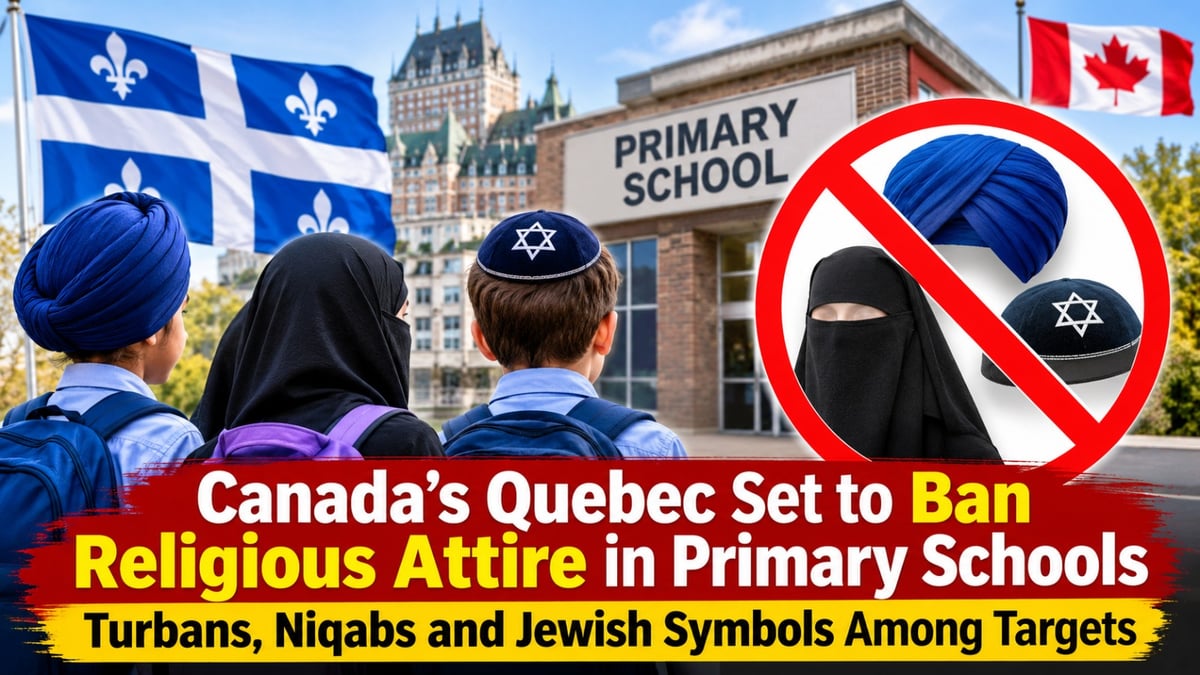
Quebec’s newly elected government in Canada is preparing to ban religious attire and symbols worn by children in primary schools, including Sikh turbans, Muslim niqabs and Jewish religious symbols.
The proposed move is likely to affect children from Sikh, Muslim and Jewish communities and has sparked a debate over religious freedom, secularism and children's rights.
The separatist Parti Québécois came to power following Quebec’s provincial election in October. The party had promised during its election campaign to extend restrictions on religious symbols to primary school students.
Education Minister Joël Arseneau has indicated that the government intends to fulfil the election promise, saying the party received a public mandate to implement its agenda.
Quebec Premier Paul St-Pierre Plamondon has also backed the proposal. In September, he said parents sending their children to school must respect the rules of educational institutions, including restrictions on religious symbols.
Quebec's restrictions on religious symbols date back to 2019, when the then Coalition Avenir Québec (CAQ) government introduced a secularism law. It prohibited certain public employees, including teachers, principals, police officers and judges, from wearing religious symbols while performing their duties.
The law has been challenged before Canada's Supreme Court.
In April, the previous government introduced further restrictions on religious activities at public universities, government-funded private institutions and childcare centres. Collective religious activities in streets and parks were also restricted.
The new government now plans to extend the scope of these restrictions to primary school children.
Anaïs Bussière McNicoll, director of fundamental freedoms at the Canadian Civil Liberties Association, has criticised the proposal, saying restrictions on religious expression in Quebec are gradually expanding.
She warned that extending the restrictions to children could create a sense of exclusion and send a message of rejection towards certain religious communities. She also questioned the need for the proposed measure, arguing that it seeks to address a problem that does not genuinely exist.