Punjab Newsline | Kathmandu
Nepal is facing one of its worst natural disasters in recent years, with the confirmed death toll from the devastating floods rising to 903, while 4,247 people are still reported missing, according to the latest figures released by the country’s National Disaster Risk Reduction and Management Authority (NDRRMA).
More than 10,000 people have been rescued from flood-hit areas so far, while at least 267 people have sustained injuries. Rescue and search operations continue across several affected districts, with thousands of security personnel deployed to locate survivors and recover victims.
The disaster has also created a major crisis at Nepal’s hydropower projects. Authorities said 933 hydropower project workers are currently unaccounted for, with several workers feared trapped inside tunnels blocked by mud, rocks and flood debris. Rescue teams are facing difficult terrain, damaged roads and continuing flood risks while trying to reach the affected sites.
Trishuli River Flood Sweeps Away Suspension Bridge
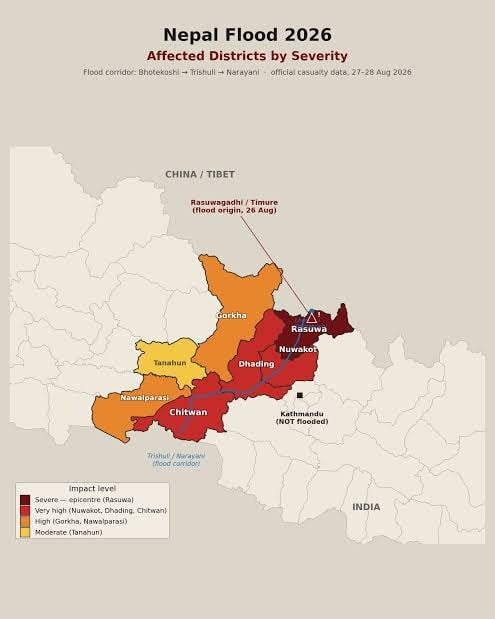
A fresh rise in the Trishuli River on Sunday caused further destruction in central Nepal. A suspension bridge connecting Ghyalchok in Gandaki Rural Municipality-8 of Gorkha district with Charaudi near the Prithvi Highway was swept away by floodwaters.
Officials said the flooding continued for around three hours, with the bridge collapsing at approximately 11:30 am. The incident has disrupted connectivity for residents of Gandaki Rural Municipality wards 7 and 8, cutting their direct access to the Prithvi Highway.
Fresh Threat of Another Flood
Authorities have warned that the danger may not be over. A large amount of debris has accumulated in the Bhotekoshi River, creating a natural obstruction and forming a lake-like body of water.
Officials fear that if the natural barrier collapses, a sudden release of water could trigger another destructive flood downstream. The possibility of additional water entering the already obstructed river system in the coming days has increased concerns among rescue agencies.
China has also issued warnings over a similar natural lake formed in Tibet. The situation has raised fears of further flooding along rivers flowing from the Himalayan region.
Rescue Operations Face Major Challenges
The ongoing rescue operation is being complicated by destroyed bridges, damaged roads, unstable terrain and the threat of additional flooding. Nepal has deployed thousands of security personnel, while specialist teams are focusing on hydropower sites where workers may still be trapped underground.
The disaster was triggered by a massive glacial and rock collapse in the Himalayan region, sending huge volumes of water, mud and debris through river valleys and destroying homes, bridges and other infrastructure.
China Reports 16 Deaths, Over 500 Missing
Across the border in China’s Tibet region, authorities have so far confirmed 16 deaths, while more than 500 people are reported missing. Rescue teams are also working in difficult conditions in the affected areas.
The scale of the disaster has prompted a major cross-border rescue effort, with Nepalese teams receiving assistance from Indian and Chinese specialists in efforts to locate missing people and reach workers trapped inside hydropower tunnels.
With the threat of further flooding still present, authorities have urged people living in vulnerable areas to remain alert and follow evacuation and safety instructions.