Punjab Newsline | Chandigarh
In a major technological boost to its ongoing “War on Gangsters” campaign, the Punjab Police has deployed an advanced Artificial Intelligence-powered system under the Punjab Artificial Intelligence System (PAIS), significantly enhancing its ability to track and dismantle organized crime networks.
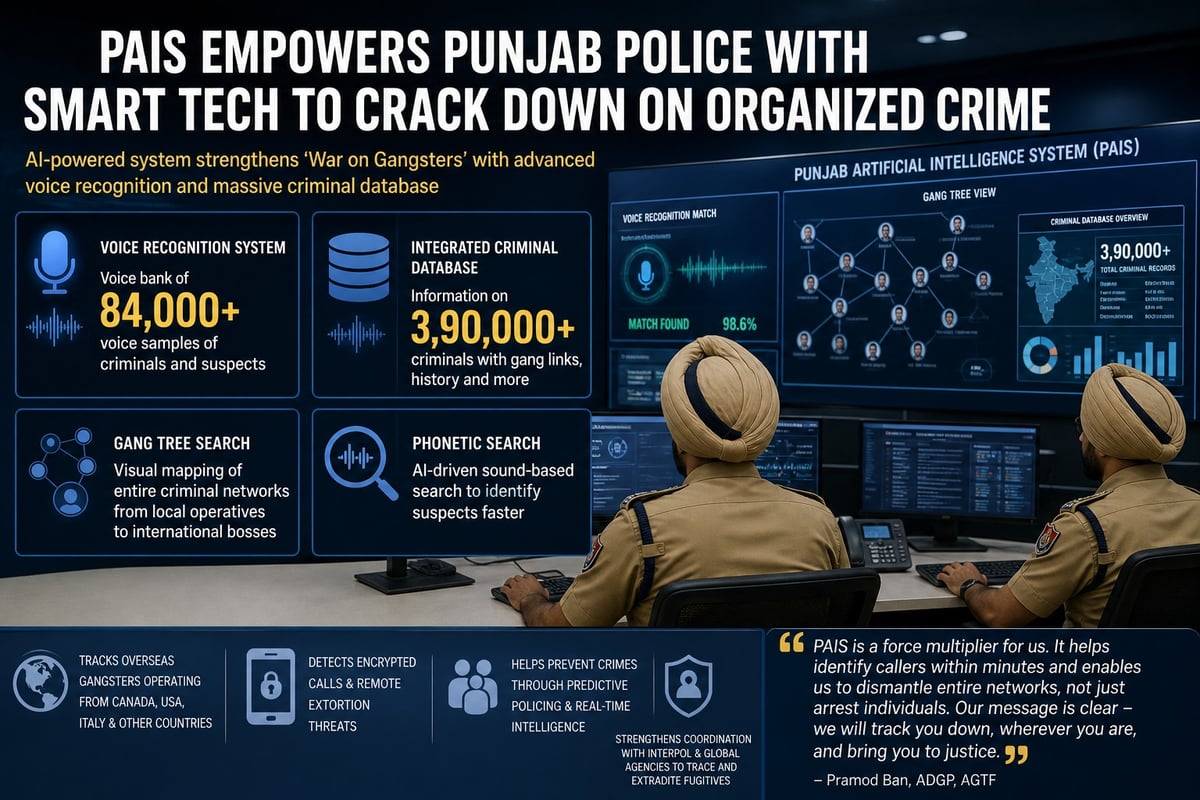
At the core of this initiative is a sophisticated voice recognition system that houses a “voice bank” of over 84,000 samples collected from criminals and suspects. This AI-driven tool is proving crucial in identifying individuals involved in extortion, threats, and other criminal activities especially those being operated remotely from abroad.
The PAIS platform goes beyond voice identification by integrating a vast database of over 390,000 criminals. It features advanced tools such as phonetic search and a “gang tree search” system, which visually maps entire criminal networks from local operatives to international masterminds.
Authorities revealed that around 60 high-risk gangsters linked to Punjab are currently operating from countries including Canada, the United States, and Italy. Law enforcement agencies have been grappling with a rising trend of “remote-controlled” extortion, where threats are issued via encrypted applications and international virtual numbers.
According to ADGP of the Anti-Gangster Task Force (AGTF), Pramod Ban, the AI-backed system has dramatically improved response times and accuracy. “For years, foreign-based gangsters exploited technology to run extortion rackets from safe havens. Under the ‘War on Gangsters’ campaign, PAIS has emerged as a force multiplier. AI-based voice matching now allows us to identify callers within minutes, enabling swift and precise action,” he said.
Officials added that the system is also enabling predictive policing helping authorities prevent crimes before they occur. In recent operations, targeted killings were foiled by tracking digital communications between foreign handlers and local operatives.
“Earlier, we handled isolated incidents. Now, with PAIS, we can trace entire networks who is funding, supporting, and executing criminal activities. This intelligence-based approach allows us not just to arrest individuals, but to dismantle entire syndicates,” Ban added.
The technology has further strengthened the AGTF’s efforts, while a dedicated Fugitive Tracking Cell is leveraging PAIS to collaborate with international agencies like Interpol. This coordination is helping accelerate the identification and extradition of criminals hiding overseas.
“This marks a shift from traditional policing to predictive policing. We can now identify threats in advance, monitor suspicious communication, and act proactively. The message is clear criminals will be tracked down, wherever they are, and brought to justice,” Ban asserted.