Punjab Newsline | New Delhi
By : Samriti Sharma
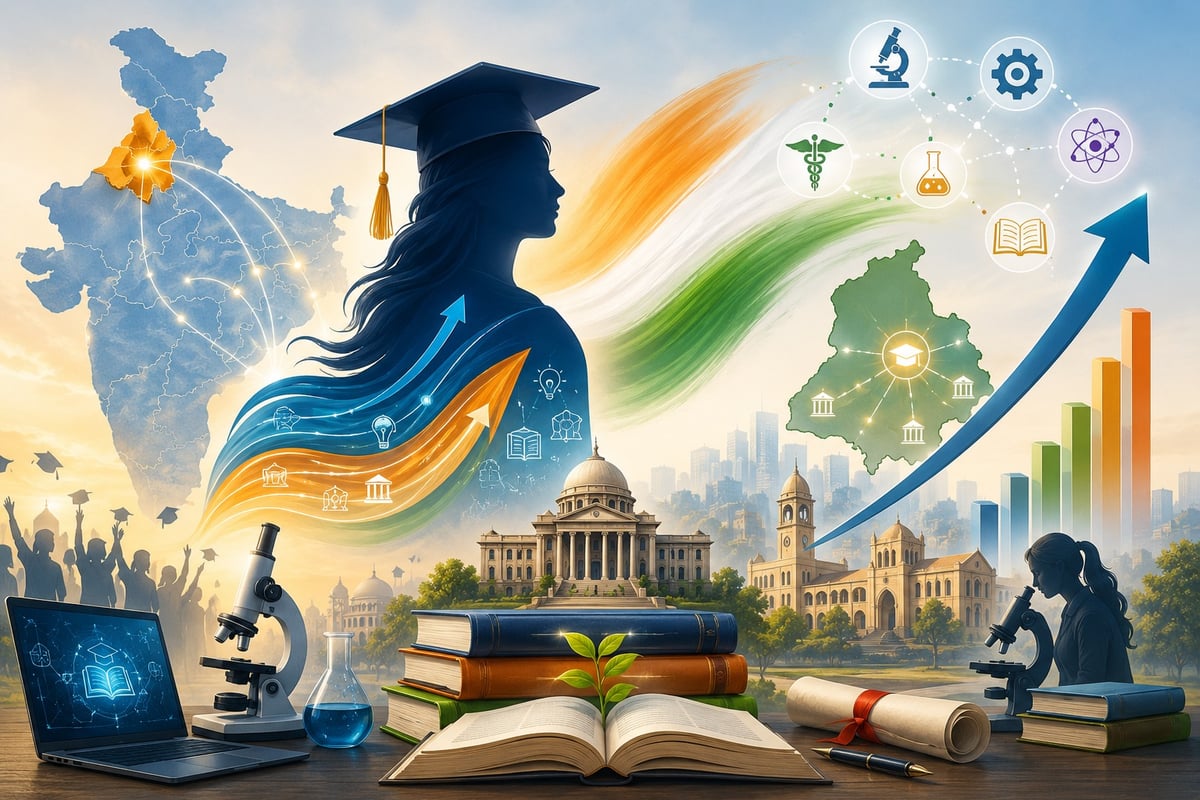
India's higher education sector has reached a historic milestone, with total enrolment touching a record 45 million (4.5 crore), according to the All India Survey on Higher Education (AISHE) 2023-24 released by the Ministry of Education. For the first time since the survey began, women have surpassed men in the Gross Enrolment Ratio (GER), signalling a significant transformation in the country's education landscape.
The report shows that the female GER stands at 31.2 percent, compared with 28.9 percent for males, reflecting growing access to higher education for women and changing social attitudes towards girls' education.
Punjab Witnesses Rising Female Participation
Punjab is also experiencing a steady rise in women's participation in higher education. While the state's overall GER is 27.9 percent, below the national average of 30 percent, female students are increasingly enrolling in research, technical and professional programmes rather than limiting themselves to traditional degree courses.
Women Emerging as the Driving Force
Over the past decade, female enrolment has increased by 42.2 percent, outpacing the growth among male students. Education experts attribute this shift to greater parental support, improved educational infrastructure, government initiatives promoting girls' education, and changing societal perceptions.
Highest-Ever Enrolment in Higher Education
AISHE 2023-24 reports that total enrolment in higher education has reached an all-time high of 45 million students. Women have played a major role in this growth, with their participation expanding across disciplines, including Science, Technology, Engineering and Mathematics (STEM), highlighting their increasing presence in innovation and technology-driven careers.
Women's Presence in Research Continues to Rise
The report also notes that PhD enrolment has increased by nearly 47 percent over the past decade, indicating that more women are moving beyond undergraduate and postgraduate education into research, innovation and advanced academic pursuits.
Employment Remains the Next Big Challenge
Despite encouraging enrolment figures, the report highlights that Punjab and several other states now face the challenge of creating adequate employment and career opportunities for highly educated women. Experts stress the need for stronger collaboration between universities, research institutions, industries, innovation centres and scholarship programmes to convert educational achievements into meaningful careers.
A Strong Indicator of Social Transformation
Educationists describe the findings as more than just statistical progress, calling them a reflection of India's broader social transformation. The growing number of educated women is expected to strengthen their role in administration, healthcare, education, research, entrepreneurship, technology and policymaking, while also contributing to long-term economic growth and social development.
The AISHE 2023-24 report underscores that India's daughters are no longer merely participants in higher education—they are increasingly shaping its future. The next challenge for governments, universities and industry will be to ensure that this educational progress is matched by equal opportunities in employment, leadership and innovation.